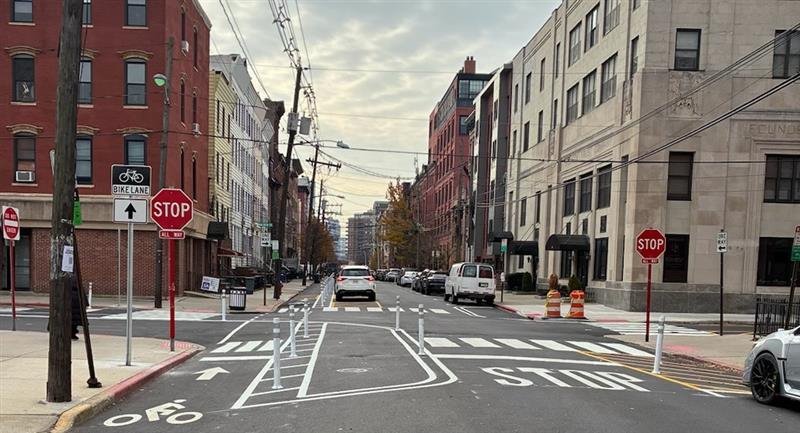
The City of Hoboken today announced an updated plan for Grand Street between Third and Eighth Streets that will restore approximately 20 on-street parking spaces, retain key pedestrian safety improvements, and preserve targeted bicycle safety improvements at intersections. The changes reflect an evaluation of the data collected during the Grand Street pilot, community feedback, and the City’s commitment to improving safety while addressing residents’ quality-of-life concerns.
The updated plan will retain pedestrian safety improvements, including shortened crossing distances and improved visibility at intersections. It will return on-street parking to pre-pilot conditions and remove individually striped parking spaces. The plan will also restore the striped, unprotected bicycle lane located within the street. To reduce the likelihood of crashes and near-misses at intersections, the bike lane will remain separated from the travel lane at the curb within the no parking areas.
“Grand Street has reinforced that improving street safety requires listening to the people who live, work, and travel along the corridor and being willing to adapt when the data and community experience show us where changes are needed,” said Mayor Emily B. Jabbour. “Our goal is to strike the right balance between quality-of-life concerns and meaningful safety improvements. This hybrid approach preserves important pedestrian protections, provides bicycle protection within existing daylit approaches, and restores approximately 20 parking spaces. We will continue working with the community to identify practical, long-term solutions that make Hoboken safer and more accessible for everyone.”
The project team collected and analyzed data to assess the Grand Street pilot project’s impact on mobility, safety, and curb management coupled with community feedback from nearly 1,300 survey responses, resident and business input, stakeholder engagement, and City Council feedback.
The team analyzed vehicle speeds, police crash reports, double-parking occurrences, bicycle ridership data, how frequently drivers stopped for pedestrians crossing the street, on-street parking capacity, emergency operations, and street sweeping operations to better understand the pilot’s effects on safety, mobility, and curbside operations. Key findings include the following:
The data also identified areas where the pilot design created trade-offs. The revised curb layout reduced on-street parking capacity between Third and Eighth Streets by approximately 20 spaces, or 14 percent, compared with pre-pilot conditions.
Community feedback from the survey highlighted support and disapproval of pilot features including concerns related to parking, access, deliveries, and the day-to-day experience of navigating the corridor:
The new plan for Grand Street aims to address both the safety benefits and quality of life concerns by incorporating the following changes:
These changes are anticipated to be completed before the end of the year. As a next step, the City will work with residents, businesses, cyclists, and other community stakeholders to develop a community-focused process to identify locations for a network of protected bike lanes with the goal of facilitating mobility balanced with the practical needs of the surrounding neighborhoods.
“Grand Street is an opportunity to learn how street designs work in practice and how we can make better decisions together by marrying data with resident feedback,” said Mayor Jabbour. “We want residents to help shape the next phase of bicycle infrastructure planning, including where protected bike lanes make the most sense and how they can be implemented in a way that works for the entire community.”
For more information and the full report on Grand Street, CLICK HERE.